
Livistona chinensis var. subglobosa
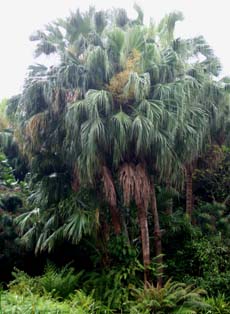
Family: Arecaceae Palm Tree
Common Name: Taiwan Fan Palm
Scientific Synonymy:
Livistona chinensis, Livistona chinensis ssp. subglobosa, Saribus subglobosus, Livistona japonica, Livistona subglobosa
Common Synonymy:
Chinese Fan Palm, Chinese fountain palm, Serdang palm. FRENCH : Palmier évantail de Chine, Palmier fontaine. GERMAN : Chinesische Fächerpalme, Chinesische Schirmpalme. SPANISH : Livistona de China.
Cold Hardiness Zone: 8b View the UK and US zone maps
Livistona chinensis var. subglobosa Information
A solitary, medium sized, water-loving, moderately slow growing, dioecious palm. Common in cultivation and locally common in the wild. It has a rough, grey-brown trunk, 12 m. (40 ft.) tall, 28 cm. (11 inch) diameter with no obvious leaf scars, and huge partially segmented, palmate (fan) leaves, 1.8 m. (6 ft.) long, 1.8 m. (6 ft.) wide, bluish-green above and pinkish beneath.
This form produces larger fruits and seeds than the Chinese form. The fruits are 2.5 cm. (1 inch) long, ovoid with a beautiful turquoise-blue colouration. The leaf-crown is densely packed with 30 - 50 highly pendulous, bluish green to glossy olive green leaves.
Livistona chinensis var. subglobosa can survive freezing temperatures to about -6.5°C (20.3°F), but freezing is best avoided. This species naturally occurs on islands in moist forest, and is heavily effected by the surrounding sea temperatures, which are constant and often form sea mist and cloud. In this type of natural environment temperature fluctuations are slight, and this palm prefers a constantly mild climate with little temperature difference between day & night, and Summer & Winter. Under extreme freezing conditions we recommend you keep this palm as dry as possible, and well wrapped up.
Identification
General Information
Distribution
Native to: Japan, Taiwan
Taiwan and the Ryukyu archipelago of Japan as far north as Aoshima Island, Japan. It is also known to have occurred on Tsushima island (at latitude 34°N) located to the south of the Korean Peninsula.
Location: Taiwan, Japan (28.248909°N, 127.836914°E)
Observations
Map may not represent the complete natural distribution. (Markers display observation data).